
Everything you need to understand a modern sailing yacht,
before stepping onboard.
7 Structured Modules
A complete learning path covering yacht familiarisation, sailing, safety, COLREGs, anchoring, navigation and marine communication.
120+ Training Videos
Short, focused lessons demonstrating real equipment, procedures and sailing techniques.
500+ Interactive Learning Points
Discover terminology, equipment, systems and practical seamanship throughout the yacht
Real Beneteau Oceanis 40.1
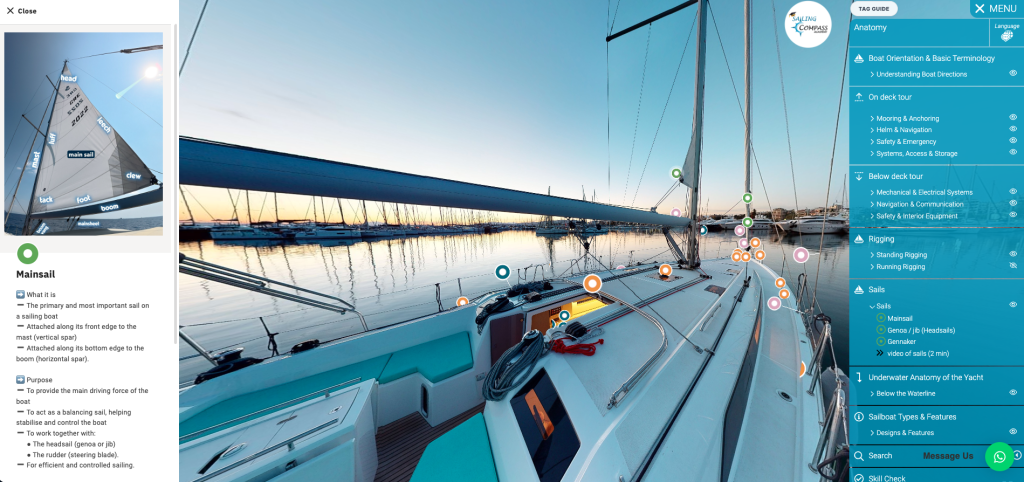
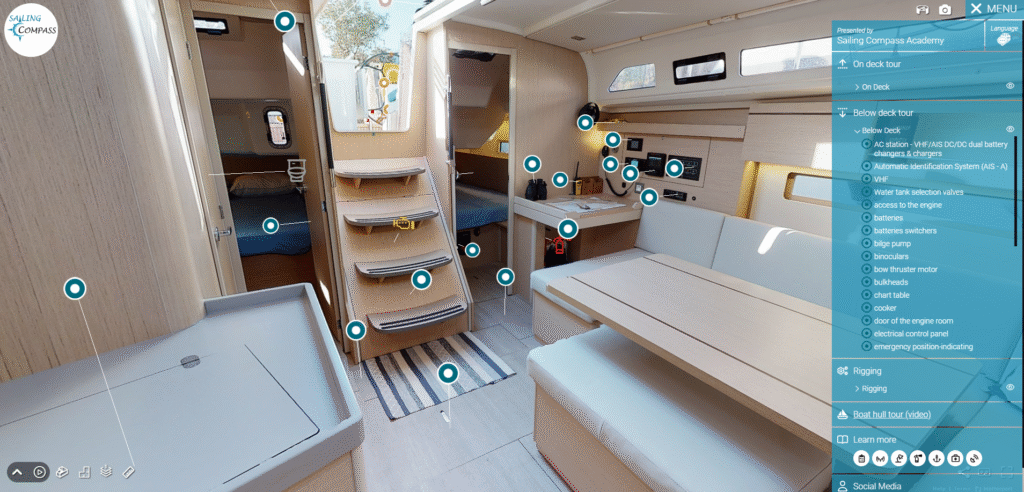
Explore a real sailing yacht in 3D and discover equipment and systems where they are actually located onboard.
Explore 7 structured modules combining video instruction, interactive 3D exploration, diagrams, simulations, quizzes and practical sailing knowledge,
all built around a real sailing yacht.
Module 1 — Yacht Familiarisation
Explore more than 120 interactive learning points across a modern cruising yacht and discover how the boat is organised, where critical equipment is located, how onboard systems connect together, and how sails and rigging function in practice.
Before stepping onboard, you’ll already know your way around the yacht.
Why this module matters
One of the biggest challenges for new sailors is simply knowing where things are.
During a yacht handover, instructors and charter managers use dozens of nautical terms while pointing at equipment all around the boat. Without familiarity, it’s easy to feel overwhelmed and forget important information.
This module helps you become comfortable with the layout, equipment and terminology of a modern cruising yacht before stepping onboard.
What you’ll explore
– Boat Orientation & Basic Terminology
- Boat directions
- Port & starboard
- Bow & stern
- Nautical terminology
- Movement & attitude
- Hull & waterline terminology
– On Deck Tour
- Mooring equipment
- Anchoring system
- Helm & navigation area
- Safety equipment
- Storage compartments
- Deck systems, access & storage
– Below Deck
- Electrical systems
- Mechanical systems
- Navigation & communication equipment
- Safety & interior equipment
– Rigging
- Standing rigging
- Running rigging
- Mast, boom, winches, clutches, halyards & sheets
– Sails
- Mainsail
- Genoa
- Gennaker
- Sail components
– Underwater Anatomy
- Keel
- Rudder
- Hull components
- Rope cutter & Propeller
– Sailboat Types & Features
- Hull types
- Keel types
- Rigging configurations
- Ropes, lines & their uses
After completing this module you’ll be able to
✅ Understand the layout of a modern cruising yacht
✅ Recognise over 100 onboard components and systems
✅ Follow a yacht handover with confidence
✅ Understand sailing terminology used by instructors and crew
✅ Locate key equipment quickly in real situations
✅ Step onboard already familiar with the boat
Module 2 — Knots, Sails & Manoeuvres
Build the practical sailing skills that transform theory into action. Learn how to handle lines, understand sail behaviour, trim sails efficiently, and perform common sailing manoeuvres with confidence.
Practice key sailing concepts through interactive simulations, short focused lessons and hands-on exercises designed to prepare you for real sailing conditions.
Why this module matters
Many sailors understand sailing theory but struggle to apply it on the water.
When the wind changes, a manoeuvre is required, or a sail needs adjustment, hesitation and uncertainty can quickly reduce both performance and confidence.
This module helps you understand how sails work, how to handle lines correctly, and how to perform essential sailing manoeuvres safely and efficiently.
What you’ll explore
Line Handling & Knots
- Line handling & deck organisation
- Essential sailing knots
- Coiling, securing & managing lines
Sailing Fundamentals
- Wind direction & apparent wind
- Points of sail
- Essential sailing terminology
- Winch handling
Sail Handling
- Mainsail handling
- Genoa handling
- Gennaker preparation & handling
- Reefing, furling & unfurling procedures
Sailing Manoeuvres
- Tacking
- Gybing
- Heading up & bearing away
- Heaving-to
Sail Trim & Configuration
- Mainsail, headsail & gennaker trim
- Sail configurations
- Advanced trim techniques
- Adjusting trim for different conditions
Interactive Learning Lab
- True vs apparent wind
- Wind angle & velocity simulations
- Boat speed exercises
Skill Check
- Knowledge assessment
- Practical understanding review
After completing this module you’ll be able to
✅ Understand how sails generate power and drive the yacht
✅ Recognise the different points of sail and their purpose
✅ Trim sails more effectively for performance and comfort
✅ Perform common sailing manoeuvres with greater confidence
✅ Organise and manage lines safely onboard
✅ Tie essential sailing knots quickly and correctly
✅ Understand what adjustments are needed as wind conditions change
Module 3 — Safety On Board
Learn the procedures, equipment, and decision-making principles that help keep you, your crew, and your yacht safe. From routine departures and arrivals to emergency situations, this module helps you prepare before you need to act.
Explore essential safety equipment, emergency procedures, first aid and AED awareness, and practical crew management techniques used onboard modern cruising yachts.
Why this module matters
Safety is not only about emergencies. It begins with preparation, awareness, and good onboard procedures.
From preparing to leave the marina and monitoring changing conditions to coordinating the crew during an emergency, knowing what to do beforehand can make a critical difference.
This module helps you develop safer habits, understand essential safety equipment, recognise developing risks, and respond more effectively when situations become challenging.
What you’ll explore
Life-Saving Equipment
- Lifejackets, lifebuoys & safety harnesses
- Distress signals & emergency equipment
- Fire-fighting equipment
- Safety lines, ladders & recovery equipment
Safe Deck Practices & Crew Procedures
- Pre-departure safety preparation
- Engine, steering & electronics checks
- Departure & arrival procedures
- Heavy weather preparation
- Night sailing safety & preparation
Liferaft
- Liferaft systems & equipment
- Deployment & boarding procedures
- Actions after boarding
- Survival management & first aid principles
Emergency Response
- Man overboard
- Fire & flooding
- Engine & electrical failure
- Emergency steering
- Dismasting
- Practical emergency scenarios
First Aid & AED
- First aid principles at sea
- Casualty assessment & recovery position
- CPR, drowning, bleeding & choking awareness
- AED familiarisation & onboard use
Engine Preparedness
- Essential engine checks
- Engine compartment familiarisation
Interactive Learning Lab
- AED interactive guide
After completing this module you’ll be able to
✅ Understand the location and purpose of critical safety equipment
✅ Prepare your yacht and crew before departure
✅ Follow safer departure and arrival procedures
✅ Respond more effectively during onboard emergencies
✅ Understand basic first aid principles and the role of an AED
✅ Recognise developing risks before they become serious problems
✅ Manage your crew with greater confidence and awareness
Module 4: COLREGs – Rules of the Road at Sea
Learn the international rules that govern vessel behaviour at sea and develop the situational awareness needed to navigate safely, predict the actions of other vessels and avoid collisions.
Through practical examples, visual scenarios and interactive exercises, you’ll learn how to interpret real-world situations and make safer decisions on the water.

Why this module matters
Knowing individual navigation rules is one thing. Applying them correctly in a developing situation is another.
Understanding the COLREGs is not simply about memorising regulations. It is about recognising situations early, understanding the responsibilities of each vessel, assessing the risk of collision, and taking appropriate action.
This module helps you develop the judgement, awareness, and practical understanding needed to navigate more safely in busy waterways and at sea.
What you’ll explore
COLREGs Foundations
- Philosophy, structure & application of the Rules
- Responsibility & good seamanship
- Proper lookout & risk of collision
- Action to avoid collision
- Restricted visibility & restricted waters
Responsibilities Between Vessels
- Hierarchy of responsibilities
- Responsibilities between different vessel types
- Practical decision-making at sea
Steering & Sailing Rules
- Sailing vessel responsibilities
- Overtaking situations
- Head-on situations
- Crossing situations
Sound Signals
- Manoeuvring & warning signals
- Restricted visibility signals
- Attention & distress signals
- Sound signalling equipment
Lights & Shapes
- Navigation lights & visibility
- Day shapes
- Power-driven & sailing vessels
- Anchored & aground vessels
- Towing, fishing & restricted vessels
- Special vessel configurations
Practical Seamanship
- Applying the Rules in real situations
- Observation, judgement & collision avoidance
Interactive Learning Lab
- COLREGs day shape trainer
- COLREGs sound signal exercises
- 360° navigation lights
- Interactive Lights & Shapes Rule Explorer
Reference Material
- Navigation Rules
- Additional sailing rules & reference material
Skill Check
- Knowledge assessment
- Situational awareness review
After completing this module you’ll be able to
✅ Identify stand-on and give-way vessels in common situations
✅ Interpret navigation lights and day shapes correctly
✅ Recognise and respond to collision risks earlier
✅ Understand sound signals and their meaning
✅ Apply COLREG rules in real-world scenarios
✅ Make safer navigation decisions under pressure
✅ Navigate more confidently around commercial and recreational traffic
Module 5 — Anchoring & Mooring Operations
Develop the skills and understanding needed to anchor, dock, and secure a yacht with greater confidence. Learn the equipment, procedures, and decision-making principles behind safe and effective anchoring and mooring operations.
From selecting a suitable anchorage to Mediterranean stern-to mooring, this module builds the practical knowledge needed for some of the most important manoeuvres onboard.

Why this module matters
For many sailors, anchoring and docking can be among the most demanding moments of a sailing trip.
Wind, depth, surrounding boats, limited space, and crew communication can quickly turn a routine manoeuvre into a challenging situation.
This module helps you understand the equipment, preparation, procedures, and crew coordination needed to approach anchoring and mooring with greater confidence and control.
What you’ll explore
Anchoring Equipment
- Primary & secondary anchors
- Anchor types, parts & rode
- Chain markings, snubbers & swivels
- Windlass, bow roller & chain locker
- Monitoring & safety equipment
Understanding the Anchorage
- Seabed & holding conditions
- Choosing a suitable anchorage
- Anchor performance in practice
- Depth, position & environmental awareness
Anchoring Procedures
- Preparation & crew communication
- Scope & anchor setting
- Monitoring for anchor drag
- Anchoring at night or in reduced visibility
- Best practices & seamanship principles
Anchoring with Shore Lines
- Preparation & step-by-step procedure
- Using a tender or swimming the line ashore
- Risks & common mistakes
- Shore line visibility & practical considerations
- Stern-to anchoring in Greece
Anchor Recovery & Problems
- Anchor recovery & boat positioning
- Stuck vs fouled anchors
- Recovering a stuck or fouled anchor
Mooring Operations
- Mooring to a buoy or pick-up line
- Mooring & lazy lines
- Docking lines
- Crew preparation & line handling
Mediterranean Mooring
- Stern-to mooring procedures
- Stern-to mooring with lazy lines
- Bow thruster use
- Short-handed docking techniques
- Stern-to docking between boats
Skill Check
- Knowledge assessment
- Practical scenario review
After completing this module you’ll be able to
✅ Select safer anchorages and assess conditions
✅ Understand how anchoring equipment works
✅ Deploy and recover an anchor correctly
✅ Set and monitor an anchor with greater confidence
✅ Use shore lines when required
✅ Understand and apply Mediterranean stern-to mooring procedures
✅ Organise your crew during docking and mooring manoeuvres
✅ Recognise and respond to common anchoring problems
Module 6 — Navigation & Situational Awareness
Develop the navigation skills needed to understand your position, interpret your surroundings, and make informed decisions on the water. Learn both traditional and electronic navigation methods used aboard modern cruising yachts.
Through practical examples, onboard equipment familiarisation and interactive exercises, you’ll learn how to navigate with greater confidence and awareness in real sailing conditions.
Why this module matters
Modern navigation is much more than following a line on a chartplotter.
A skipper must continuously understand the yacht’s position and movement, interpret navigation marks, monitor hazards, and maintain awareness of the surrounding environment.
Electronic navigation is a powerful tool, but it works best when supported by a solid understanding of navigation principles and situational awareness.
This module helps you develop the knowledge, awareness, and judgement needed to navigate more effectively in real sailing situations.
What you’ll explore
Navigation Fundamentals
- Essential navigation terminology
- Nautical miles & knots
- Bearings & courses
Onboard Navigation Equipment
- Paper charts & pilot books
- Magnetic & hand-bearing compasses
- Chartplotter, GPS & AIS
- Speed & depth instruments
- Traditional navigation tools
Buoyage, Marks & Lights
- IALA Maritime Buoyage System
- Lateral & cardinal marks
- Isolated danger, safe water & special marks
- Emergency wreck marks
- Lighthouses & light characteristics
Traditional Navigation
- True, magnetic & compass north
- Compass error
- Latitude & longitude
- Plotting a course
- Position fixing
- Dead reckoning & estimated position
- Safety margins & clearing bearings
Boat Movement & Position
- Boat speed vs speed over ground
- Heading vs course over ground
- Wind effect & leeway
- Current
Electronic Navigation
- Practical chartplotter use
- GPS position monitoring
- AIS awareness, CPA & TCPA
- Cross-checking electronic position
- Limitations of electronics
- Backup navigation strategies
Navigation Awareness
- Core seamanship principles
- Night navigation principles
- Situational awareness & cross-checking
Interactive Learning Lab
- Light pattern trainer
- Lighthouse light pattern trainer
- Boat speed & movement exercises
After completing this module you’ll be able to
✅ Understand how to determine and monitor your position
✅ Use both traditional and electronic navigation tools
✅ Interpret navigation marks and buoyage systems correctly
✅ Understand lighthouse signals and characteristics
✅ Maintain greater situational awareness while navigating
✅ Recognise potential hazards earlier
✅ Combine electronic information with visual observation and basic navigation principles
Module 7 — Marine Communication & VHF Operations
Learn the principles and procedures behind clear and effective communication at sea. Understand VHF radio procedures, emergency communications, maritime safety systems, and the communication practices used in real onboard situations.
From routine marina calls to distress communications, this module helps you understand what to say, when to say it, and how to respond when communication matters most.
Why this module matters
Using a marine radio can feel unfamiliar, even for sailors who are otherwise comfortable onboard.
In routine situations, unclear communication can create confusion or delay. In an emergency, communicating the right information clearly and efficiently can become critical.
This module helps you understand marine communication procedures, VHF radio practices, and emergency communication principles, so you can communicate more effectively with marinas, other vessels, and relevant maritime services.
What you’ll explore
Marine Communication Foundations
- Purpose & principles of marine communication
- Skipper responsibilities & radio watchkeeping
- MMSI, call signs & vessel identification
- GMDSS structure & sea areas
- Digital Selective Calling (DSC)
Emergency Communication
- Mayday & Mayday Relay
- Pan-Pan & Sécurité
- False distress & cancellation procedures
- Man overboard communication
- Alternative satellite & mobile communications
Routine VHF Communication
- Radio discipline & phonetic alphabet
- Calling another vessel
- Communicating with ports & authorities
- Communication in developing situations
Emergency Communication Equipment
- Fixed & handheld VHF
- GMDSS backup systems
- EPIRB & PLB
- AIS integration
- Emergency communication escalation
Position & Tracking
- GPS / GNSS positioning
- Reading & communicating your position
- Chartplotter information
- Automatic Identification System (AIS)
Communication in Real Situations
- Situational awareness
- From observation to communication
- Decision-making under pressure
- Equipment failures & communication decisions
- Communication in restricted visibility
Interactive Learning Lab
- VHF & safety simulation
- Practical communication exercises
Equipment Reference
- Chartplotter
- VHF
- EPIRB
- AIS manuals
After completing this module you’ll be able to
✅ Understand how marine radio communication works
✅ Use standard VHF communication procedures
✅ Communicate more confidently with marinas and other vessels
✅ Understand emergency communication protocols
✅ Recognise and respond appropriately to distress situations
✅ Report your position and intentions clearly
✅ Communicate more effectively during routine and emergency operations
Sailing Compass Academy
From First Steps to Real-World Sailing Skills
Progress through 7 structured modules designed to connect sailing knowledge with a real yacht, practical situations, and interactive learning.
Explore. Understand. Practise. Sail with confidence.